

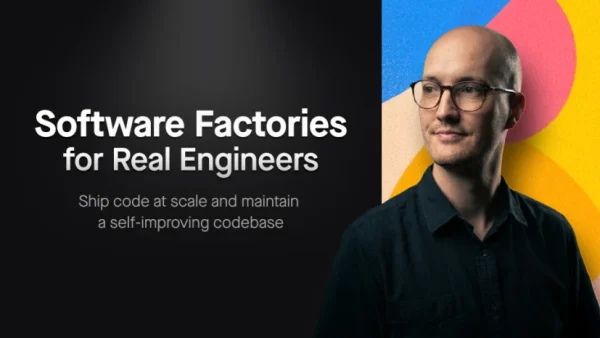


Matt Pocock – Software Factories for Real Engineers
Build Reliable Software Systems with AI Coding Agents and Real Engineering Practices
Artificial intelligence is changing the way developers build software. Coding agents can now handle many programming tasks. However, generating code quickly does not always mean producing reliable, maintainable software. Without proper engineering practices, AI-generated code can introduce bugs, create unnecessary complexity, and make existing projects harder to maintain.
Matt Pocock – Software Factories for Real Engineers explores a more structured approach to AI-powered software development. It focuses on combining established software engineering principles with coding agents to build systems that can handle real-world development work.
Rather than simply asking AI to write more code, the course explores how engineers can design an environment where coding agents work with clear instructions, appropriate restrictions, automated checks, and meaningful feedback.
The goal is to help developers move beyond manually supervising every coding task. Instead, they can learn to design a software factory that supports consistent development, code quality, and continuous improvement.
If you want to understand how AI agents can contribute to serious software engineering, this course offers an opportunity to explore an important approach to modern development.
What Is Software Factories for Real Engineers?
Software Factories for Real Engineers is a technical training program by Matt Pocock. It explores how to design and build a software factory that uses AI coding agents to complete development tasks within a controlled engineering environment.
A software factory is more than an automated code generator. It combines infrastructure, engineering knowledge, automated processes, and review systems. Together, these elements help coding agents work on larger tasks while maintaining quality standards.
For example, instead of asking an agent to make random changes, engineers can provide a clear specification, define coding standards, and establish automated checks. The system can then investigate tasks, implement changes, and prepare work for review.
Furthermore, the approach considers the entire development process. This includes understanding an existing codebase, planning complex work, testing changes, reviewing code, and improving the system over time.
Matt Pocock presents these ideas through practical engineering concepts and a working software factory example.
What You Can Expect to Learn
1. Understanding AI Coding Agents
AI coding agents can perform many programming activities. However, they need the right context and direction to produce useful results.
This course explores how agents work within a broader engineering system. You can develop a better understanding of their responsibilities, limitations, and working environments.
Moreover, you can explore how to delegate well-defined tasks instead of constantly correcting an agent during development.
This approach helps engineers think about the quality of the overall process, not just the speed of code generation.
2. Domain Language and Software Documentation
Clear communication is essential when building complex applications. Developers need consistent terminology to understand business requirements and technical decisions.
The course explores domain language, shared glossaries, and architecture decision records (ADRs).
These practices help developers and AI agents understand the same project concepts. As a result, instructions can become clearer and misunderstandings can be reduced.
You will also explore how documentation can support larger development tasks and provide useful context for coding agents.
3. Planning Large Development Tasks with Wayfinder
Large software projects cannot always be completed effectively in a single AI session.
They often require investigation, planning, specifications, and smaller implementation tasks. Without a structured approach, important requirements can easily be overlooked.
The course introduces the Wayfinder approach to planning larger pieces of work.
You can explore how to map a project, investigate risky areas, prototype ideas, and turn development requirements into actionable specifications.
Consequently, coding agents can work with a clearer understanding of what needs to be built.
4. Automated and Human Code Review
Code review plays an important role in maintaining software quality.
However, reviewing every change manually can become difficult when coding agents produce large amounts of code.
This course explores different layers of review, including automated checks, automated code review, and human review.
You can understand how these methods work together. Automated systems can identify problems, while human engineers provide judgment where it matters most.
Furthermore, the course explores how to make pull requests easier to understand and review.
5. Better Codebase Design
A well-designed codebase makes development easier for both humans and AI agents.
Poor architecture, unclear boundaries, and complicated dependencies can make even simple changes difficult.
The training explores software design principles such as deep modules, module boundaries, seams, and adapters.
It also covers working with legacy code and making existing applications easier to test.
These concepts are useful when working with established projects. Instead of starting from scratch, engineers can improve the structure of their existing systems.
6. Feedback Loops and Automated Testing
Automation is only useful when it helps maintain the quality of the final result.
Therefore, the course explores how to create reliable feedback loops that detect problems during development.
Topics include:
- Automated checks and testing.
- Custom lint rules.
- Coding standards.
- Type checks and quality controls.
- Mutation testing.
- Frontend application verification.
- Diagnosing software bugs.
In particular, mutation testing helps evaluate whether tests can detect intentionally introduced changes. This provides another way to examine the effectiveness of a testing system.
As a result, developers can build stronger confidence in their automated development processes.
7. Building a Working Software Factory
One of the central parts of Software Factories for Real Engineers is learning how the different engineering components work together.
The course explores a practical software factory example using GitHub Actions.
You can examine how a system can investigate tasks, organise work, assign implementation responsibilities, track progress, and support code review.
It also explores sandboxing, infrastructure, permissions, and running coding agents.
In addition, the training considers how to design a factory for your own codebase and team.
The focus is not simply on copying an existing automation setup. Instead, it encourages engineers to understand the underlying design decisions and adapt the system to their requirements.
Who Should Take This Course?
Matt Pocock – Software Factories for Real Engineers is particularly relevant to people interested in combining professional software engineering with AI-powered development.
It may be suitable for:
Software Developers: Developers who want to explore how coding agents can support everyday programming tasks and larger software projects.
Senior Engineers: Experienced engineers interested in improving development workflows, architecture, code quality, and technical decision-making.
Full-Stack Developers: Developers working across frontend and backend systems who want to understand how AI agents can contribute to complex applications.
Technical Leads: Team leaders exploring ways to establish consistent engineering standards and delegate development work more effectively.
Software Architects: Professionals interested in codebase design, system architecture, automation, and maintainable development environments.
AI-Assisted Developers: Programmers already using tools such as Claude Code, Cursor, GitHub Copilot, or other AI coding assistants.
Engineering Teams: Teams looking to understand how AI-assisted workflows can fit into established development practices.
Some familiarity with programming and software engineering will help you get more value from the technical material.
Key Benefits of Learning Software Factories
Develop a Better Approach to AI Development
Using AI coding tools effectively requires more than writing prompts. You need to understand how to provide context, define boundaries, and evaluate the generated work.
This course explores those engineering foundations.
Improve Software Quality
Automated checks, testing, and review processes can help identify problems before they become larger issues.
You can learn how these practices contribute to a more controlled development environment.
Understand Complex Codebases
Working with existing software often requires careful investigation. Domain knowledge, architecture documentation, and codebase design can make this process easier to manage.
Reduce Repetitive Development Work
A properly designed software factory can delegate suitable tasks to coding agents. Consequently, engineers can spend more time on architecture, problem-solving, and important technical decisions.
Build More Maintainable Systems
Good software engineering is about more than completing today’s task. It also involves making future changes easier.
The course explores how codebase improvements, testing, and clear boundaries support long-term maintainability.
Learn Practical Automation Concepts
By studying a working software factory, you can better understand how infrastructure, agents, automated review, and development workflows connect.
Apply Engineering Knowledge to AI Tools
The course focuses on Claude Code CLI, but the engineering principles can also be applied to other coding assistants.
This makes the underlying concepts useful beyond a single AI development tool.
Why Software Factories Matter in Modern Development
The introduction of AI coding agents has created new opportunities for software developers. Tasks that once required significant manual effort can now be delegated to intelligent tools.
However, greater automation also introduces new challenges.
An agent may misunderstand a requirement, make an unsuitable architectural decision, or produce code that passes basic checks but still contains problems.
That is why engineering fundamentals remain important.
A reliable software factory combines automation with appropriate controls. It provides agents with the information they need while creating mechanisms to evaluate their work.
For example, clear specifications help define expectations. Automated testing checks implementation quality. Code review adds another layer of protection. Meanwhile, good architecture makes the project easier to understand.
Together, these practices create a more dependable approach to AI-assisted development.
Software Factories for Real Engineers explores how to bring these elements together into a practical system.
About Matt Pocock
Matt Pocock is a software developer and educator known for making complex programming and TypeScript concepts easier to understand.
He is also associated with Total TypeScript and AI Hero training programs.
His teaching focuses on practical software engineering knowledge. In Software Factories for Real Engineers, he explores how established engineering principles can be applied to modern AI coding workflows.
The course connects software architecture, testing, documentation, automation, and coding agents into one broader development approach.
Frequently Asked Questions
1. What is Matt Pocock – Software Factories for Real Engineers?
It is a technical training program focused on building software factories using AI coding agents and established software engineering principles. It explores automation, code quality, architecture, testing, and development workflows.
2. Who is the instructor?
The course is created and taught by Matt Pocock, a software developer and educator known for his programming and TypeScript training.
3. Does the course cover AI coding agents?
Yes. Understanding and working with AI coding agents is central to the training. It explores how to organise their work and establish reliable engineering controls.
4. Does it teach Claude Code?
Yes. The training focuses on the Claude Code CLI. However, the engineering principles can also be applied to other AI coding assistants.
5. What is a software factory?
A software factory is an organised development system that combines coding agents, infrastructure, specifications, automated checks, and review processes.
Its purpose is to help automate suitable software tasks while maintaining engineering standards.
6. Does the course cover software architecture?
Yes. Codebase design is an important subject. The training explores deep modules, module boundaries, legacy code, and making software easier to test and maintain.
7. Will I learn about automated testing?
Yes. The course covers automated checks, custom lint rules, mutation testing, and frontend verification.
These concepts help developers establish stronger quality controls.
8. Is this course suitable for beginners?
The course is primarily relevant to people interested in software engineering and AI-assisted development. A basic understanding of programming and software development will help you follow the technical concepts.
9. Can I apply the concepts to my existing projects?
The training explores designing a software factory for an existing codebase and team. It also uses a provided example codebase to demonstrate the concepts.
10. Is this course only about writing code faster?
No. Its focus is broader than coding speed. It explores how to improve reliability, code quality, architecture, automation, and the overall engineering process.
11. Does the course cover GitHub Actions?
Yes. GitHub Actions is used to demonstrate a working software factory and its automation workflows.
12. What should I know before starting?
Familiarity with programming, software development, and AI coding tools will be helpful. You should also be interested in software architecture, testing, and modern development practices.
Start Exploring the Future of Software Engineering
AI coding agents are creating new possibilities for developers. However, building dependable software still requires engineering judgment, good architecture, clear specifications, and effective testing.
Matt Pocock – Software Factories for Real Engineers explores how these fundamentals can be combined with AI automation to create a more structured development environment.
From domain language and codebase design to automated review, feedback loops, and software factory infrastructure, the training covers important ideas for engineers working with modern coding agents.
If you want to go beyond basic AI code generation and understand how to build more reliable, maintainable, and scalable development workflows, this course is worth exploring.
Take your software engineering knowledge further and discover a more thoughtful approach to building software with AI.
Be the first to review “Matt Pocock – Software Factories for Real Engineers”
Related products


Reviews
There are no reviews yet.