

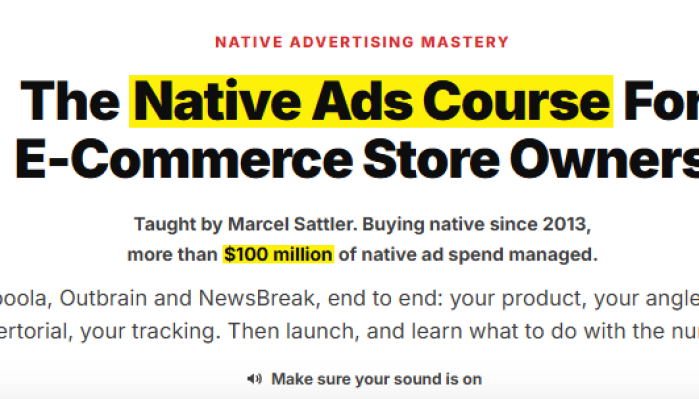


Marcel Sattler – Native Advertising Mastery for E-Commerce
Master Native Advertising Strategies for E-Commerce Growth
Discover the world of native advertising with Marcel Sattler – Native Advertising Mastery for E-Commerce. This course is focused on an important area of digital marketing: using native advertising to reach potential customers and promote e-commerce products.
In today’s competitive online marketplace, attracting visitors is only part of the challenge. Businesses also need effective ways to connect with the right audience. Native advertising offers an approach that blends promotional content with the look and feel of the platform where it appears.
As a result, native advertising can help e-commerce marketers explore new ways to introduce products, attract attention, and reach potential buyers.
Marcel Sattler – Native Advertising Mastery for E-Commerce is relevant to people interested in understanding native advertising and its role in online business. Whether you are exploring paid traffic or looking to expand your digital marketing knowledge, this course offers a subject-focused learning opportunity.
If you want to learn more about native advertising for online stores, this course is worth exploring.
Course Overview
Native advertising is a form of online promotion designed to fit naturally into the content environment of a website or platform. Unlike traditional display advertisements, native ads are created to match the surrounding content experience.
For e-commerce businesses, this advertising approach can provide another way to introduce products to relevant audiences.
Marcel Sattler – Native Advertising Mastery for E-Commerce focuses on the connection between native advertising and e-commerce marketing. It is particularly relevant to people who want to understand how this advertising method fits into a broader online marketing strategy.
E-commerce businesses operate in an increasingly competitive environment. Therefore, understanding different traffic sources and advertising approaches is valuable.
Native advertising is one of the approaches marketers can explore when developing their customer acquisition strategies.
What Is Native Advertising?
Native advertising refers to paid promotional content that matches the format and appearance of the platform where it is displayed.
For example, a sponsored recommendation on a content website may appear alongside regular articles. Although it is promotional, its presentation follows the website’s content format.
This approach creates a different advertising experience compared with traditional banner advertisements.
However, successful native advertising requires more than simply placing an advertisement. Marketers must consider their audience, advertising message, product relevance, landing page, and overall customer experience.
For e-commerce businesses, these factors are important because potential customers need clear information before making a purchase decision.
What Learners Can Expect to Learn
Although the exact course syllabus should be checked before purchasing, the subject connects to several important areas of e-commerce advertising.
1. Understanding Native Advertising Platforms
Different platforms provide different advertising opportunities.
Some focus on content discovery. Others distribute sponsored recommendations across publisher websites and digital publications.
Understanding these differences is important. It helps marketers evaluate advertising opportunities based on their products and audiences.
2. Identifying the Right Target Audience
Audience research plays an important role in digital advertising.
An online store may attract several types of customers. However, each group has different interests and purchasing motivations.
Understanding these differences can help businesses create more relevant advertising messages.
Moreover, knowing your audience makes it easier to evaluate which promotional channels deserve attention.
3. Creating Effective Advertising Content
Native advertising depends heavily on relevant and engaging content.
An advertisement should communicate a clear message. It should also give potential customers a reason to explore the product.
Important creative considerations include:
-
Writing attention-grabbing headlines.
-
Creating relevant advertising messages.
-
Choosing suitable product images.
-
Developing informative promotional content.
-
Communicating product benefits clearly.
-
Including effective calls to action.
However, advertising should always remain honest and transparent.
4. Understanding Advertorials and Sponsored Content
Advertorials combine advertising with editorial-style content.
They can introduce products through informative articles, product explanations, and relevant recommendations.
For example, an online store selling fitness products could use educational content to introduce products related to common customer interests.
This approach allows businesses to provide useful information while presenting relevant products.
5. Understanding E-Commerce Conversion Strategies
Getting visitors to your website is only the beginning.
The next step is providing a smooth experience that encourages visitors to explore your products.
An effective customer journey connects the advertisement, landing page, product information, and checkout process.
Important elements include:
-
Relevant landing pages.
-
Clear product descriptions.
-
High-quality product images.
-
Transparent pricing information.
-
Customer reviews and trust signals.
-
Simple checkout experiences.
Therefore, advertisers should consider the complete customer journey rather than focusing only on advertising clicks.
6. Measuring Advertising Performance
Understanding campaign performance is important for making better marketing decisions.
E-commerce advertisers commonly monitor several performance indicators.
These include:
-
CTR (Click-Through Rate): Measures how many people click an advertisement.
-
CPC (Cost Per Click): Measures the cost of generating advertising clicks.
-
CPA (Cost Per Acquisition): Measures the advertising cost associated with acquiring a customer.
-
Conversion Rate: Measures how many visitors complete a desired action.
-
ROAS (Return on Ad Spend): Compares advertising revenue with advertising expenditure.
By understanding these metrics, marketers can evaluate their advertising activities more effectively.
7. Exploring Campaign Optimization
Advertising campaigns require regular evaluation.
Marketers can investigate different headlines, images, audiences, and landing pages. They can then use performance data to identify potential improvements.
Furthermore, structured testing makes it easier to understand which changes influence campaign performance.
These are relevant concepts within native advertising and e-commerce marketing. They should not be interpreted as a confirmed list of lessons included in this particular course.
Who Is This Course Suitable For?
Marcel Sattler – Native Advertising Mastery for E-Commerce may interest people who want to explore alternative advertising strategies for online businesses.
Here are some audiences who may find the subject relevant.
E-Commerce Business Owners
Running an online store requires more than listing products. Business owners also need ways to reach potential customers.
Native advertising offers another promotional approach to investigate alongside existing marketing channels.
Dropshipping Entrepreneurs
Dropshipping businesses depend on product promotion and customer acquisition.
Understanding different advertising formats can help entrepreneurs explore alternative ways to introduce products to potential buyers.
Digital Marketing Professionals
Digital marketers often work with multiple advertising channels.
Learning about native advertising can broaden their understanding of paid media and online promotion.
Media Buyers
Media buyers manage advertising budgets and evaluate campaign performance.
The subject may be useful for professionals interested in understanding additional advertising opportunities.
Affiliate Marketers
Affiliate marketers depend on effective traffic generation and promotional strategies.
Native advertising is one potential traffic channel to understand when researching different approaches to online promotion.
Marketing Beginners
People starting their digital marketing journey may also be interested in this subject.
However, beginners should check the course’s actual difficulty level before purchasing.
Key Benefits of Learning Native Advertising
Understanding native advertising can help develop valuable digital marketing knowledge.
Here are some potential benefits of exploring this advertising approach.
1. Explore Additional Traffic Sources
Native advertising introduces another way to reach potential customers. Consequently, businesses can investigate opportunities beyond traditional display advertising and social media promotions.
2. Develop Better Audience Understanding
Successful marketing starts with understanding customers. Audience research can help businesses create more relevant promotional messages.
3. Improve Advertising Creativity
Native advertising places importance on content presentation. Therefore, understanding headlines, visuals, and messaging can help marketers develop stronger advertising concepts.
4. Understand Customer Acquisition
Customer acquisition involves attracting potential buyers and encouraging them to explore a business. Learning about different advertising formats can expand your understanding of this process.
5. Make Better Marketing Decisions
Advertising metrics provide useful information about campaign performance. As a result, marketers can make more informed decisions when evaluating their promotional activities.
6. Expand Your E-Commerce Marketing Knowledge
Understanding multiple advertising approaches can help online business owners develop a broader marketing perspective.
7. Explore Alternative Promotional Strategies
Different products and audiences may respond to different advertising formats. Native advertising provides another approach worth investigating.
Why Is Native Advertising Important for E-Commerce?
Competition in e-commerce continues to make customer acquisition an important business consideration.
Online stores compete for attention across search engines, social networks, marketplaces, and content platforms.
Therefore, relying on a single promotional channel may limit the opportunities a business explores.
Native advertising provides an additional format for introducing products through relevant content environments.
For example, a customer reading an article about home improvement might discover a sponsored recommendation for a related product.
Similarly, someone exploring business content might encounter a relevant recommendation from an online store.
The main consideration is relevance.
An advertisement should match the interests of its intended audience. Additionally, the landing page should deliver the information promised in the advertisement.
When these elements work together, native advertising can become part of a broader e-commerce customer acquisition strategy.
Native Advertising vs Traditional Advertising
Understanding the difference between advertising formats can help businesses evaluate their options.
Traditional display advertising often uses banners and clearly separated promotional placements.
Native advertising, on the other hand, is designed to match the appearance and general format of the platform displaying it.
Both approaches have potential uses in digital marketing.
However, their effectiveness depends on several factors, including:
-
Target audience.
-
Product relevance.
-
Advertising budget.
-
Creative quality.
-
Platform selection.
-
Landing page experience.
-
Campaign performance.
Therefore, businesses should evaluate advertising channels according to their objectives rather than assuming one format is always better.
Frequently Asked Questions
1. What is Marcel Sattler – Native Advertising Mastery for E-Commerce?
It is an educational course offering focused, according to its title, on native advertising and its application to e-commerce businesses. Check the product information for the confirmed course contents.
2. What is native advertising?
Native advertising is a paid promotional format designed to match the appearance and experience of the platform where it appears. It can help businesses introduce products through sponsored content and recommendations.
3. Who should consider this course?
E-commerce business owners, dropshipping entrepreneurs, digital marketers, media buyers, and people interested in online advertising may find the subject relevant.
4. Is native advertising useful for e-commerce?
Yes, native advertising can be used to promote e-commerce products. However, results depend on the product, audience, advertising content, platform, and overall customer experience.
5. Is this course suitable for beginners?
The exact experience level has not been confirmed. Beginners should review the available course information before purchasing.
6. Will I learn how to create native advertisements?
The course title indicates a focus on native advertising. However, the exact practical lessons and exercises should be verified through the course syllabus.
7. Does native advertising work for dropshipping?
Native advertising can be explored as a promotional channel for dropshipping products. However, campaign performance depends on product demand, audience relevance, advertising quality, and other business factors.
8. Can native advertising replace Facebook Ads or Google Ads?
Not necessarily. Native advertising is another promotional option. Businesses can evaluate it alongside social media advertising, search advertising, and other traffic sources.
9. What is the difference between native advertising and display advertising?
Display advertising commonly uses traditional banner formats. Native advertising is designed to blend with the content environment of the publishing platform.
10. Does this course guarantee sales or business growth?
No specific sales or business outcomes should be assumed. Advertising performance depends on multiple factors, including budget, product demand, competition, and campaign execution.
11. Should I learn native advertising for my online store?
If you want to explore additional customer acquisition strategies, native advertising is a relevant subject to investigate. Understanding different promotional channels can help you make more informed marketing decisions.
12. What should I check before purchasing?
Review the available curriculum, course format, included resources, access conditions, and purchase terms. This will help you understand whether the program matches your requirements.
Final Thoughts
Marcel Sattler – Native Advertising Mastery for E-Commerce is a course offering for people interested in understanding native advertising within the e-commerce industry.
Native advertising provides an alternative approach to online promotion. It connects advertising with relevant content experiences and offers another way to introduce products to potential customers.
Whether you manage an online store, work in digital marketing, or explore dropshipping opportunities, understanding different advertising formats can be valuable.
Most importantly, effective advertising requires continuous learning, audience research, and performance evaluation.
If native advertising is an area you want to explore, consider this course as a potential addition to your digital marketing learning journey.
Make an informed purchasing decision by reviewing the available course details and confirming exactly what is included.
Be the first to review “Marcel Sattler – Native Advertising Mastery for E-Commerce (November 2026)”
Related products


Ecommerce course


Ecommerce

Ecommerce
Benjamin Facciani – A-Z Direct Response Course(August 2026 Updated + Lifetime Free Updates)

Ecommerce


Reviews
There are no reviews yet.